

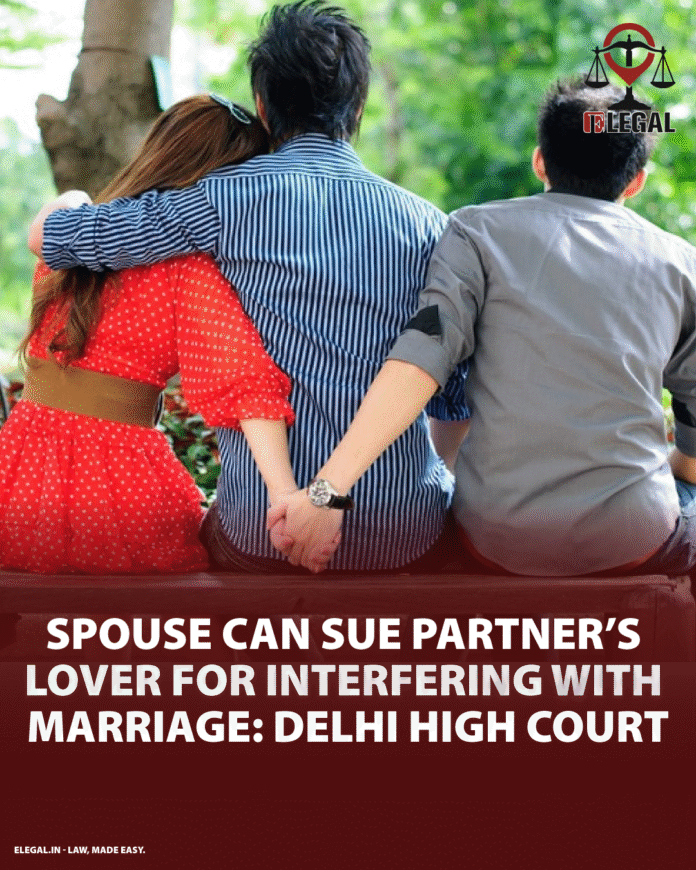
New Delhi, September 15, 2025: The Delhi High Court has held that a married person can maintain a civil suit for damages against their partner’s lover in cases of adultery, where there is intentional interference that causes the breakdown of the marriage.
A bench of Justice Purushaindra Kumar Kaurav, while hearing a suit filed by a woman seeking damages of ₹4 crore, clarified that such claims can be made under the tort of “alienation of affection (AoA)”, a civil wrong derived from Anglo-American common law. Although not codified under Indian law, it allows a spouse to sue a third party for disrupting marital consortium, intimacy, and companionship.
Key Observations by the Court
The High Court explained that a spouse’s right to marital companionship is legally protectable, and third parties must refrain from intentionally disrupting that relationship.
Quoting from the order, Justice Kaurav stated:
“A spouse is held to possess a protectable interest in marital consortium, intimacy, and companionship, the correlative legal duty would be that any third party must not intentionally and wrongfully interfere with that relationship by acts calculated to alienate the affection of a spouse to the other spouse, which the other spouse is legally entitled to.”
However, the Court cautioned that damages cannot be claimed if the unfaithful spouse’s conduct was “completely voluntary, not induced and uncoerced”, since every spouse retains the inherent liberty to make personal choices.
What Needs to Be Proved
For a civil action based on alienation of affection to succeed, the petitioner must establish:
- Intentional and wrongful conduct by the defendant directed at alienating the marital relationship.
- Clear causation linking the defendant’s conduct to injury suffered by the petitioner.
- That the loss claimed is capable of rational and legal assessment.
Background of the Case
The case arose from a suit filed by Shelly Mahajan, who alleged that her husband’s partner intentionally interfered in their marriage. The couple had married in 2012, but the husband filed for divorce in 2023 citing cruelty.
The High Court held that such civil actions are maintainable as independent tortious claims, even if parallel matrimonial proceedings are pending between the spouses. It clarified that the relief sought in civil court—compensation for tortious interference—is distinct from matrimonial remedies.
Broader Legal Context
The Court referred to Pinakin Mahipatray Rawal v. State of Gujarat (2013) 10 SCC 48, where the Supreme Court discussed alienation of affection but noted the rarity of such claims in India. It also observed that:
- Indian jurisprudence has acknowledged the concept of AoA, but no reported civil case in India has yet resulted in damages being granted solely on this ground.
- The tort remains judicially recognized but has not been formally adopted into codified law.
The Court further addressed the impact of the Supreme Court’s landmark ruling in Joseph Shine, which decriminalised adultery. It clarified:
“The decision in Joseph Shine decriminalised adultery; it did not create a license to enter into intimate relationships beyond marriage, free from civil or legal implications…While the exercise of personal liberty is not criminal and therefore cannot attract penal sanction by the State as a matter of public offence, such conduct may nevertheless give rise to civil consequences.”
Conclusion
Summons were issued in the case, with the High Court holding that the plaint could not be rejected at the threshold stage. The judgment reinforces the principle that while adultery is no longer a criminal offence, it may still give rise to civil liability where wrongful interference in marriage is proven.
Case Title: Shelly Mahajan v. Ms. Bhanushree Bahl & Anr.
Citation: 2025 LiveLaw (Del) 1156